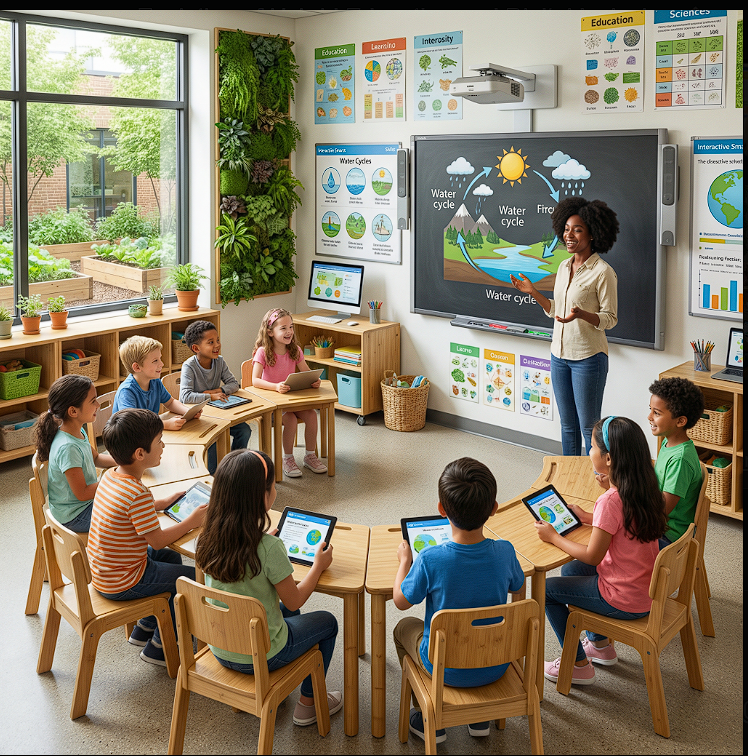
For years, digital learning was often treated as an add-on to traditional education—useful in some cases, convenient in others, but rarely seen as the core architecture of schooling itself. That has changed dramatically. Around the world, hybrid learning, which combines classroom instruction with online tools and platforms, is no longer viewed merely as a backup plan for crisis moments. It is increasingly being adopted as a strategic model for the future of education, one designed to make learning more flexible, more accessible and more responsive to the realities of modern life. UNESCO
The shift matters because education systems are under pressure from multiple directions at once. Schools and universities are being asked to serve larger and more diverse populations, support students across different locations, prepare learners for digital economies and provide pathways not only for children and teenagers, but also for working adults who need to reskill throughout their lives. In that environment, a rigid one-size-fits-all model of education is becoming harder to defend. Hybrid learning offers a way to expand opportunity without completely abandoning the value of face-to-face instruction. World Bank
What makes this moment especially significant is that the conversation has matured. During the pandemic years, the world experienced emergency remote learning on a massive scale, often with mixed results. Today, however, the debate is less about simply putting lessons online and more about how to build thoughtful systems that combine the strengths of in-person teaching with the reach and adaptability of digital tools. Major education institutions now speak of flexibility, personalized learning, resilience and lifelong learning not as future possibilities, but as current design priorities. UNESCO
At its best, hybrid learning is not just about screens in classrooms or recorded lectures on a portal. It is about restructuring education so that time, place and pace become more adaptable to learners’ needs. A student may attend discussions and lab work on campus, review recorded material later online, submit assignments digitally and receive feedback through learning platforms. A working parent may join evening lessons remotely while completing occasional in-person assessments. A university may deliver part of a programme online to widen access for students outside major cities. In each case, digital tools do not replace education; they extend how it can be delivered. UNESCO GEM Report
That flexibility is one reason hybrid learning has moved to the center of education policy. UNESCO says digital innovation can expand access to educational opportunities, advance inclusion, improve the relevance and quality of learning, support lifelong learning pathways and strengthen the management of education systems. The organization also argues that technology has become a social necessity for protecting education as a right, especially in a world affected by conflict, displacement and repeated crises. In other words, hybrid learning is not only a pedagogical choice. It is increasingly viewed as part of how countries build more resilient education systems. UNESCO
The case for hybrid learning becomes even stronger when viewed through the lens of access. The World Bank notes that the world continues to face a severe learning and skills crisis, with more than half of 10-year-olds in low- and middle-income countries unable to read and understand an age-appropriate text, and with a particularly heavy burden falling on Sub-Saharan Africa. The same institution also points to the reality that vast numbers of children and young people remain out of school globally, while many others lack internet access at home. Those statistics expose a difficult truth: technology can widen opportunity, but only if access gaps are addressed deliberately. Hybrid education is powerful, but only when infrastructure, affordability and inclusion are treated as central concerns rather than afterthoughts. World Bank
This is why the strongest advocates of digital education no longer speak about technology in isolation. They speak about systems. The World Bank argues that countries need a clear vision, a strategic and hands-on policy role, context-sensitive planning and sustained support for teachers if digital learning is to improve outcomes at scale. UNESCO’s 2023 Global Education Monitoring report makes a similar point, saying that technology in education must be introduced on the basis of evidence and with attention to whether it is appropriate, equitable and scalable. The message from global institutions is increasingly consistent: hybrid learning works best when it is designed around learning, not around gadgets. World Bank UNESCO GEM Report
One of the biggest beneficiaries of this shift is the non-traditional learner. For working adults, the conventional education timetable has long been a barrier. Fixed daytime schedules, geographic distance from institutions and family responsibilities can make further study difficult even for highly motivated people. Hybrid learning changes that equation. It allows adults to study after work, learn from home, revisit lectures asynchronously and continue pursuing qualifications without fully stepping away from employment. In labour markets where technology is rapidly changing job requirements, that flexibility is becoming economically significant, not just educationally convenient. Coursera
Evidence from online learning platforms shows why the model is attracting so much attention. Coursera’s 2025 Learner Outcomes Report, based on responses from more than 52,000 learners across 179 countries, found that career advancement is the dominant motivation for learning online. The report says 86% of learners come to build new skills and transform their careers, while 91% reported a positive career outcome after completing a course or programme. Nearly half said they experienced a salary increase, and large majorities reported gains in both technical and soft skills. Those findings reinforce the idea that digital and hybrid learning are now deeply tied to employability, promotion and professional mobility. Coursera
That connection to the workplace is especially important because the modern economy rewards continual learning. Skills are expiring faster, digital literacy is becoming foundational across sectors and employers increasingly expect workers to adapt as tools and processes change. In this context, hybrid education supports a lifelong learning model in which people move in and out of formal study at different stages of life. They may pursue certificates, professional development modules, micro-credentials or postgraduate qualifications through combinations of online and in-person engagement. Education, in other words, is becoming less like a one-time phase and more like a recurring activity throughout adulthood. UNESCO Coursera
Higher education institutions are already responding to that reality. The 2025 EDUCAUSE Students and Technology Report describes a learning environment shaped by technology, flexibility, workforce preparation and well-being. It found that students continue to recognize the value of flexible learning formats, including hybrid models, because they offer greater access, personalization and convenience. At the same time, the report shows that students are not asking for digital learning at any cost. They want it to be structured clearly, delivered consistently and backed by reliable institutional support. EDUCAUSE
That nuance is important. The future of education is not simply “more online.” In fact, the EDUCAUSE findings suggest many students still prefer on-site experiences for certain kinds of activities, especially those involving interaction, labs, discussions and presentations. Younger learners in particular often favour campus-based experiences, while older students are more likely to prefer online formats. That pattern points to a more sophisticated future in which hybrid learning is valued precisely because it allows institutions to match the mode of delivery to the nature of the learning task and the profile of the learner. Flexibility does not mean every learning activity should move online; it means institutions should be intelligent about what belongs where. EDUCAUSE
This is one reason the term “hybrid” remains more useful than the broader phrase “online learning.” A fully online programme may work well for some learners and subjects, but hybrid education recognizes that in-person teaching still plays an important role in motivation, social development, mentoring and hands-on practice. It preserves the value of physical learning communities while using digital tools to overcome constraints of time and place. That balance makes hybrid learning attractive not only to universities, but also to schools, technical institutes and workforce training providers that want to modernize without losing the human dimension of education. UNESCO GEM Report
The human dimension matters because good teaching remains the decisive factor. Both UNESCO and the World Bank stress that technology alone does not transform learning; teachers do. Digital systems can organize materials, provide analytics, enable simulations and extend access, but they do not automatically create trust, curiosity, discipline or critical thinking. Teachers still shape how learners engage, how content is contextualized and how support is given when students struggle. That is why the current evolution of hybrid learning increasingly emphasizes teacher preparation, digital pedagogy and professional development rather than hardware procurement alone. UNESCO GEM Report World Bank
In practical terms, successful hybrid learning requires teachers who can design learning across multiple environments. They must know how to structure lessons so that online activities are meaningful rather than repetitive, how to maintain student engagement across synchronous and asynchronous tasks, how to assess learning fairly and how to use digital tools without overwhelming students. This is not a minor adjustment. It represents a rethinking of instructional design. When institutions fail to support teachers through that transition, hybrid learning can quickly become fragmented, inconsistent and frustrating. EDUCAUSE UNESCO GEM Report
Students notice those differences immediately. The EDUCAUSE report found that 70% of students agreed that expectations for engagement in hybrid courses were clearly communicated, and 59% said their instructors were effective at teaching hybrid courses, but fewer than half believed instructors followed consistent hybrid practices across courses. That gap may sound technical, but it reveals a major challenge. Learners can adapt to different platforms and schedules if expectations are coherent. What they struggle with is inconsistency—when one course is well designed, another is improvised and a third uses technology without clear purpose. In hybrid learning, quality control matters as much as access. EDUCAUSE
Infrastructure is another make-or-break issue. Reliable internet, functioning devices, accessible platforms and technical support are the invisible foundations of hybrid education. Without them, the flexibility that digital learning promises can turn into exclusion. UNESCO has warned that during the COVID-19 school closures, countries without sufficient ICT infrastructure and well-resourced digital learning systems suffered the greatest disruptions and losses, and that as many as one-third of students worldwide were left without access to learning during prolonged closures. Those lessons continue to shape current policy thinking. Education systems now know that digital readiness is not optional if they want continuity during future shocks. UNESCO
Yet the equity challenge goes beyond crisis preparedness. If hybrid learning becomes a mainstream model, then the digital divide becomes an education divide. Students with strong connectivity, quiet study spaces and personal devices will naturally benefit more unless systems intervene. UNESCO’s humanistic approach to digital education explicitly centres marginalized groups, including low-income learners, girls, learners with disabilities and linguistic or cultural minorities. That emphasis is essential because hybrid learning can either democratize education or reproduce existing inequality in a more technologically sophisticated form. Policy choices determine which path prevails. UNESCO
For countries across Africa, including Kenya, this debate is particularly relevant. On the one hand, hybrid learning offers a chance to widen access to quality content, support teacher development, reach rural learners and create more flexible pathways into higher education and professional training. On the other hand, the region also faces uneven internet access, affordability pressures, infrastructure gaps and differences in institutional capacity. That means the most effective hybrid learning strategies will likely be those that are adapted to local conditions—using mobile-friendly platforms, low-bandwidth solutions, offline access where possible and targeted support for underserved communities. Global evidence suggests there is no universal blueprint. Context matters. World Bank
There is also a deeper curricular question at stake: what exactly should students learn in a hybrid future? Digital education is not only about where learning happens, but also about what capabilities learners need in order to thrive. UNESCO points to digital literacy and digital competencies as central priorities for both teachers and students, while the wider policy conversation increasingly includes problem-solving, adaptability, collaboration and responsible engagement with AI-driven tools. Hybrid learning environments can support those goals because they mirror the mixed digital-physical realities in which people now work and live. UNESCO
This has become even more urgent in the age of generative AI. The EDUCAUSE report shows that students increasingly see AI as relevant to their future work, even though many feel underprepared by their institutions. Most do not view such tools as replacements for human work, but as productivity aids for research, content creation, analysis and idea development. That finding suggests that hybrid education may become the bridge through which institutions introduce not only digital delivery, but also digital fluency—teaching students how to use emerging tools critically, ethically and effectively. EDUCAUSE
Still, the enthusiasm around hybrid learning should not obscure the risks. UNESCO’s 2023 Global Education Monitoring report cautions that technology can be both helpful and harmful depending on how it is deployed. It argues that the potential of education technology depends on three broad conditions: access to technology, governance and regulation, and teacher preparation. That framework is valuable because it shifts the debate away from simplistic optimism. A platform can improve access, but it can also create data privacy concerns. A digital assessment system can increase efficiency, but it can also narrow what is measured. A recorded lecture can improve convenience, but it can also reduce interaction if poorly integrated. UNESCO GEM Report
Quality assurance therefore becomes central to the next phase of digital learning. Institutions must ask harder questions than whether technology is present. They must ask whether it improves comprehension, supports diverse learners, preserves academic standards and gives students meaningful ways to interact with peers and teachers. They must also measure whether flexible access translates into real retention, completion and labour-market outcomes. Hybrid education will be judged not by how modern it looks, but by whether it helps learners succeed. World Bank Coursera
The institutions most likely to thrive in this new era are those that treat hybrid learning as an ecosystem rather than a platform. They will invest in teacher training, curriculum redesign, student support, analytics, device access, well-being services and clear expectations across programmes. They will recognize that digital convenience alone is not enough; students also need belonging, structure and confidence. They will use technology to remove friction, not to add confusion. And crucially, they will understand that flexibility is not the opposite of quality. Done well, it is one of the conditions that makes quality possible for more people. EDUCAUSE UNESCO GEM Report
This is also why hybrid learning is becoming a strategic issue for governments, not just institutions. When public systems invest in digital education, they are shaping national capacity for recovery, inclusion and competitiveness. Hybrid learning can support continuity during emergencies, extend educational reach to remote communities, make lifelong learning more realistic and help align education with digital labour markets. But public leadership remains vital. The World Bank argues that governments must play a strategic role in evidence-based policy, deliberate tailoring and navigating trade-offs in digital investment. Left entirely to market forces, digital education can become fragmented and unequal. World Bank
For newsroom readers, the bigger takeaway is this: hybrid learning is no longer a side story in education. It is one of the main stories. It is reshaping how institutions define access, how adults return to study, how students prepare for work and how governments think about the future resilience of national learning systems. It is also forcing education leaders to confront uncomfortable questions about equity, quality and preparedness. That tension is exactly why the trend matters so much. Hybrid learning is not simply a technical innovation. It is a structural shift in how education is imagined and delivered. UNESCO World Bank
The next chapter will likely be defined by institutions that move beyond emergency habits and build intentional hybrid models around evidence and inclusion. Some will succeed by combining strong teaching with smart technology. Others will struggle because they mistake digitization for transformation. The difference will lie in whether they understand the real lesson of the past few years: education systems do not become future-ready when they buy more tools. They become future-ready when they use those tools to expand human opportunity. In that sense, hybrid learning is not just about connecting classrooms to the internet. It is about connecting education to the realities of the 21st century. UNESCO GEM Report EDUCAUSE Coursera
For publishers and education stakeholders alike, that makes digital and online learning one of the defining education trends to watch. The institutions that embrace hybrid models thoughtfully stand to widen access, serve more diverse learners and better prepare students for a world where learning does not stop at graduation. The ones that ignore the shift risk becoming less relevant to the learners they claim to serve. Hybrid education is not perfect, and it is not a cure-all. But as flexibility, accessibility and lifelong learning move higher on the global agenda, it is increasingly clear that hybrid learning is not a temporary experiment. It is becoming the new normal. UNESCO World Bank